How the Columbus property context affects the scope
The building type affects staging, work hours, tenant protection, rooftop equipment coordination, drainage review, access routes, and closeout documentation.

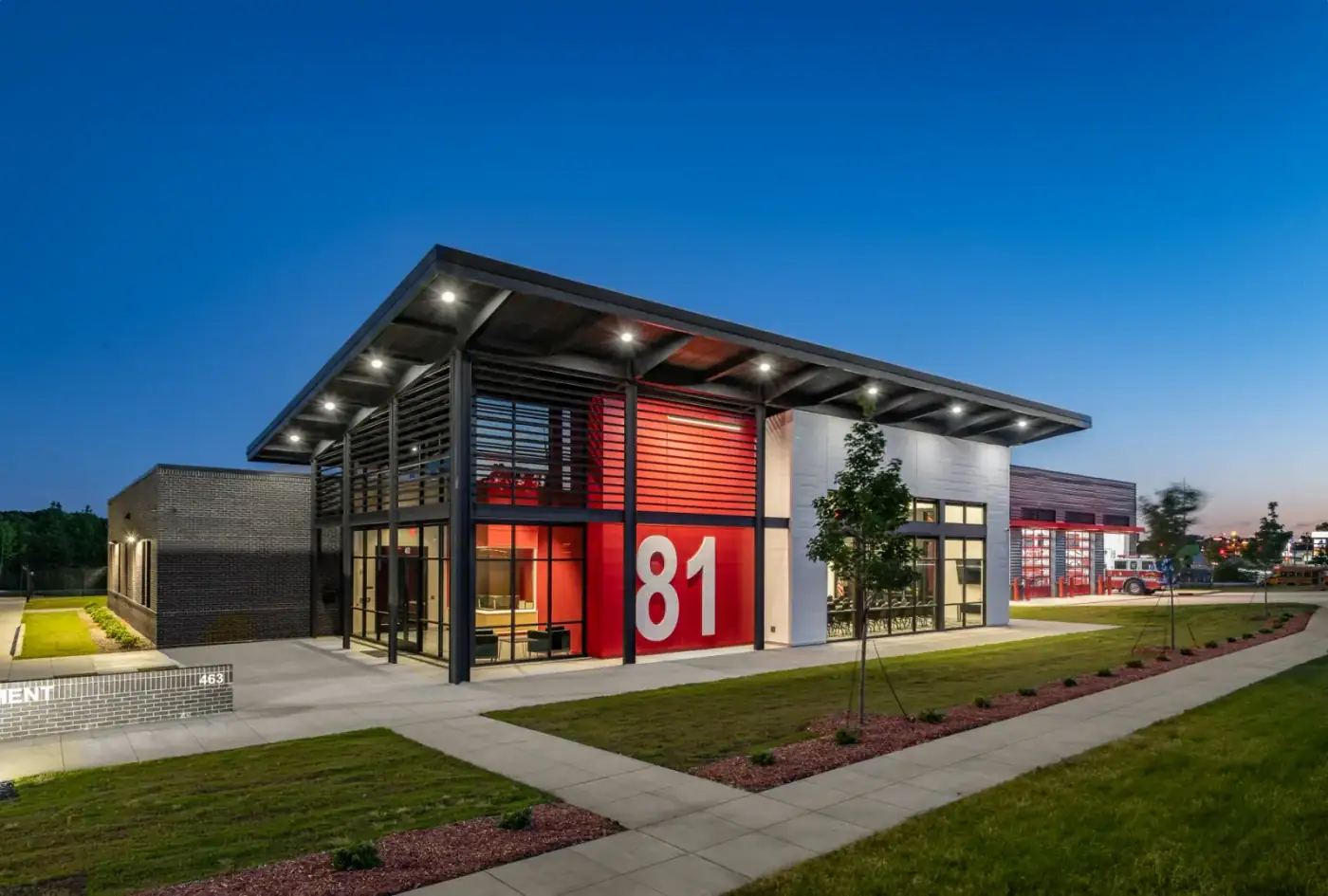
Property Type for Columbus commercial properties
A fire station roof protects a building that cannot stop working. When a call comes in, the apparatus bay doors have to open and the trucks have to roll, regardless of weather, time of day, or whether a roofing crew happens to be on site. That single fact shapes everything about how these roofs are built and maintained. An emergency services facility is a 24/7 critical operation, and its roof has to deliver long-life, low-maintenance performance while construction work happens around an operation that never pauses for a leak, a re-roof, or a storm. Roofing a station is an exercise in operational continuity as much as in waterproofing.
Central Ohio is served by a dense network of these facilities: Columbus Division of Fire stations across the city, township and suburban departments in Dublin, Washington Township, and Violet Township, and the EMS and dispatch buildings that back them up. These are public buildings in ASHRAE climate zone 5A, a cold and humid region that pushes roughly 65 to 70 freeze-thaw cycles through every roof detail each year, adds winter snow and ice-dam loading, and then bakes the same membrane in humid summer heat. Because they are funded through municipal capital budgets and built to last decades, station roofs reward durable systems and disciplined long-term planning far more than the cheapest first cost.
The building type affects staging, work hours, tenant protection, rooftop equipment coordination, drainage review, access routes, and closeout documentation.
The result is a property-specific roof plan that protects the building use while giving ownership a clear scope, schedule, access plan, and budget path.
Questions
Yes. Stations are re-roofed while fully operational by keeping the apparatus bays clear and deployable at all times, confining work to controlled sections that are opened and closed within a single window, and coordinating continuously with station officers so the work never blocks a call. No staging blocks a bay door and no overhead hot work happens above an occupied bay. The station keeps responding throughout the project.
For long municipal service life we specify robust single-ply membranes like reinforced TPO or PVC, durable EPDM, or multi-ply modified bitumen and built-up assemblies, all heavier than minimum spec, over R-25 polyiso with a cover board. Paired with an NDL manufacturer warranty and verified FM and UL wind ratings, these systems are built to match the decades of service a public building is expected to deliver.
Each is treated as a long-life penetration. Generator and diesel exhaust stacks get heat-tolerant flashing detailed for the soot and temperature near the termination, antenna and communications mounts are curbed and sealed so dispatch equipment can be serviced without disturbing the membrane, and a hose-drying tower is flashed as a dedicated structure. Walkway pads protect the membrane along the routes crews use to service all of this equipment.
Share the building address, roof history, current concern, timing, and access constraints. We will give you a practical next step for inspection, repair, maintenance, coating, or replacement planning.
Contact Commercial Roofers of Columbus