Commercial Roof Insurance Claim Assistance in Columbus, OH

Scroll
Commercial Roof Insurance Claim Assistance in Columbus, OH

Insurance claims for Columbus commercial roofs

Commercial Roof Insurance Claim Assistance in Columbus, OH

Filing a commercial roof claim in Franklin County starts long before an adjuster ever sets foot on the building. Every insurer requires proof: dated photographs by roof zone, measured damage areas, a material takeoff, and a narrative tying the loss to a specific weather event or mechanical failure. We are a roofing contractor, not a public adjuster or attorney. Our role is to inspect the roof, document what we find, and put together a scope of repair that an adjuster can review and price against. We do not file claims, negotiate settlements, or represent ownership's interests to the carrier.

Central Ohio's commercial roof stock runs the full range — flat TPO and EPDM membranes over Rickenbacker-area distribution centers, built-up and modified bitumen on older Short North and downtown adaptive-reuse buildings, standing-seam metal on newer suburban flex space near the fab-driven growth corridors, and gravel-ballasted systems on aging OSU-adjacent commercial blocks. A documentation package that works for a 400,000-square-foot logistics roof looks different from one for a repurposed warehouse loft, and we scope each one to the building it belongs to.

What a Columbus commercial roof claim actually requires

Most Ohio commercial property policies require the loss to be reported within a defined window after the event, with proof that ties observed damage to that specific date. We pull the roof's history, note the membrane type and age, and separate storm-related damage from ordinary wear before a single photo goes into the file. Underwriters look for consistency between the claimed event, the weather record, and what is physically visible on the deck and membrane — gaps in any of those three cost owners time and money.

Damage documentation, zone by zone

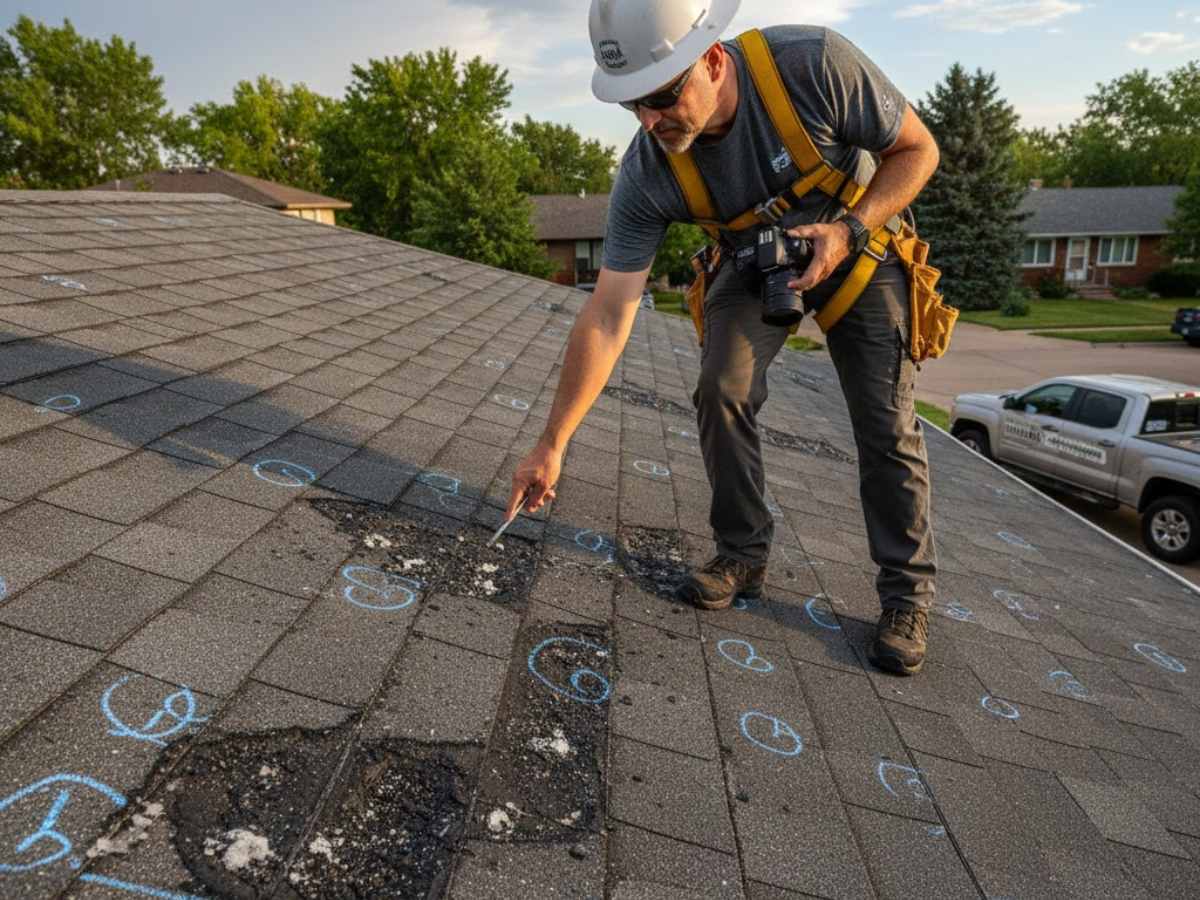
We walk the roof in sections, photographing each zone against a diagram of the building footprint, drains, and penetrations. Measurements are recorded in square feet per zone rather than a single building-wide estimate, because adjusters and estimators price repairs by area and material, not by a lump-sum guess. Moisture scans and infrared readings are added where wet insulation is suspected, since a membrane can look intact from above while the substrate underneath has already failed.

Meeting the adjuster on the roof

When ownership wants us present for the adjuster's inspection, we walk the roof alongside them, point to the documented zones, and answer technical questions about the membrane, the attachment method, and the damage mechanism. We are there to make sure nothing gets missed or misread — not to argue the settlement. Any dispute over coverage or valuation goes back to the owner, the broker, and, where retained, the owner's public adjuster.

Framing the complete repair scope

A defensible scope covers more than patching the damaged area. It accounts for code and ordinance requirements that trigger once a percentage of the roof is being replaced, matching requirements where a partial repair would leave mismatched membrane, and any related flashing, drain, or parapet work exposed by the same event. Leaving those items out of the initial scope is one of the most common reasons a Columbus commercial claim gets revisited months later.

Questions

Commercial roof insurance claim questions

Does commercial property insurance cover roof replacement?

Most Ohio commercial property policies cover roof damage caused by a covered peril — wind, hail, fire, or a qualifying weather event — subject to the policy's exclusions, deductible, and loss-settlement basis. Whether the payout supports full replacement or a repair depends on the extent of the damage and what the policy language allows. We do not interpret coverage; that determination sits with the carrier and, where applicable, the owner's broker or public adjuster.

What does the commercial roof claim process look like?

In general terms: the loss is reported to the carrier, an adjuster is assigned, the roof is inspected, and a scope and estimate are developed for the repair or replacement. We support the documentation and inspection stages — photographs, measurements, and a technical scope — so the owner and the adjuster are working from the same accurate picture of the roof.

What if a Columbus commercial roof claim comes back denied or underpaid?

A denial or a low estimate often traces back to incomplete documentation — damage that wasn't measured, a zone that wasn't photographed, or code-required work that wasn't included in the original scope. We can re-inspect the roof, add any documentation that was missing the first time, and provide an updated scope for the owner or their public adjuster to submit. We do not negotiate the claim ourselves.

Is repair or full replacement the right call after storm damage?

That depends on the roof's age, remaining service life, the extent of the damage, and whether a partial repair can be matched to the existing membrane without creating a warranty or performance problem. We lay out the condition findings and the tradeoffs for ownership; the decision on repair versus replacement is ultimately the owner's, informed by the adjuster's determination on coverage.

Do you work directly with public adjusters on Columbus claims?

Yes. We're your roofing contractor, not a public adjuster — we document and substantiate the roof damage so you and your adjuster, public or carrier-side, work from an accurate, complete scope. If ownership has retained a public adjuster, we share our inspection findings and scope directly with them.

Talk through a commercial roof insurance claim.

Share the building address, the weather event or damage you're seeing, and any deadline your carrier has given you. We will give you a practical next step for inspection, documentation, or a repair scope.

Contact Commercial Roofers of Columbus